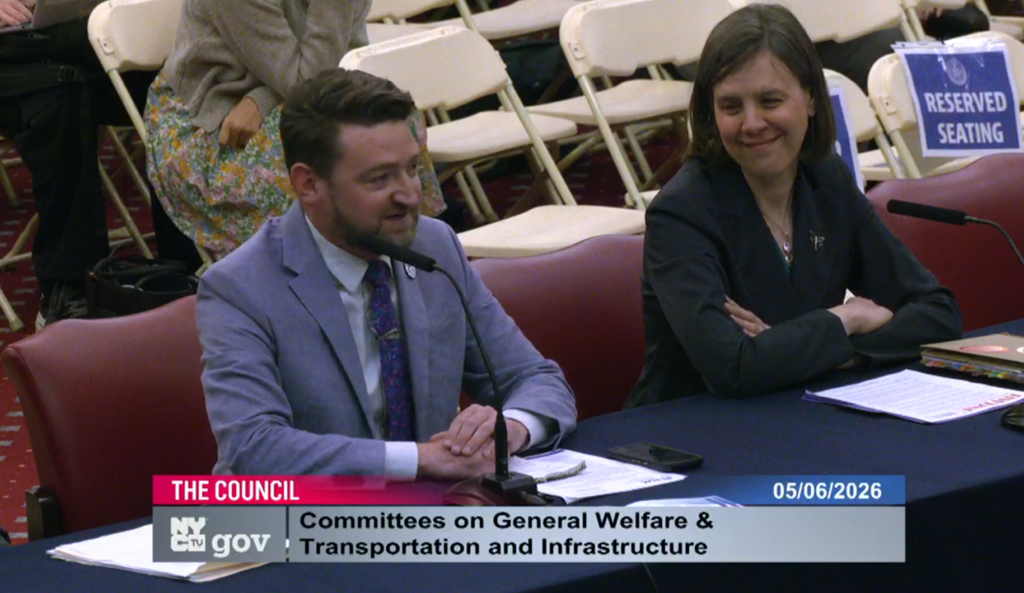
New York City Council Joint General Welfare and Transportation Hearing on Fair Fares
Good afternoon, I’m Brian Fritsch, Associate Director of the Permanent Citizens Advisory Committee to the MTA, PCAC. For nearly 50 years, PCAC has served as the official voice of riders on the MTA system. A huge thank you to Speaker Menin, General Welfare Chair Hudson, and Majority Leader and Transportation Chair Abreufor holding this hearing today and continuing to prioritize expanding this program, improving equitable access to affordable transit for hundreds of thousands of New Yorkers.
At no point since the Great Depression has affordability been so vital to so many New York City residents. As the MTA recently noted, transit plays a huge role in that complicated equation, and one of the very few ways New York City is more affordable than other parts of the country. Yet we can do so much more.
First launched in 2019, Fair Fares offers half-fare subway, bus, and paratransit rides to low-income New Yorkers ages 18-64, and is a crucial lifeline of affordability for over 360,000 currently enrolled individuals. The program began in 2019 with an income limit of 100% of the Federal Poverty Level (FPL) and was expanded incrementally to 120% in 2023, 145% in 2024, and 150% in 2025, following staunch advocacy from our organizations and partnership with the city and MTA. The city currently allocates just over $96 million in baseline funding to the Fair Fares program.
The Fair Fares program can literally change people’s lives. It offers an unparalleled opportunity to expand access to opportunity, jobs, education, and more, but far too few people qualify under the currently too-low eligibility threshold: if you make minimum wage, you almost certainly make too much. Too few of the people who do qualify are enrolled, and that’s a lost opportunity: New Yorkers who could be saving up to $910 per year in transit costs are instead getting nothing at all.
As we discussed in more detail in our report from December of last year, Universal Affordable Transit for New York, no other city program has the power to improve transportation equity – and lives – while simultaneously addressing our city’s affordability crisis. Even if our buses and paratransit become free, millions of struggling New Yorkers will still need to use the subway. Last year, over 65% of taps from Fair Fares users were on the subway. Fair Fares also helps riders avoid fare evasion by ensuring fewer riders are unable to pay, and comes as the MTA is about to begin testing new fare gates that will make it much harder to avoid paying.
For these reasons, we believe it’s time to unlock the full potential of the Fair Fares program with the five program changes:
1. Expand Fair Fares to 300% of the Federal Poverty Level (FPL) (individual- $46,950, four-person household- $96,450). This would allow an estimated 2.1 million New Yorkers to participate in the program at 300% of the FPL, including minimum wage workers, for the first time.
Additional Cost beyond the FY26 baseline: ~$125 – $155 million
2. Fully free for households under 150% of the FPL (individual- $23,475, four-person household- $48,225). This would allow for an estimated 1.3 million New Yorkers to have unlimited access to subway, bus, and paratransit service. Deepening affordability is essential to the riders who need it most.
Additional Cost beyond the FY26 baseline: ~$150 – $175 million
3. Expand Fair Fares with half-priced fares on MTA Express Buses and CityTickets on the LIRR and Metro-North railroads within New York City, drastically reducing commute times for tens of thousands of New Yorkers in subway deserts.
4. Automatic Enrollment of qualified households to improve the current enrollment rate. Currently, only around a third of eligible households are enrolled, a dismal amount. According to a new survey from the Community Service Society of New York, automatic enrollment could boost program uptake by 50% to around 570,000 enrollees, immediately unlocking benefits for nearly 200,000 New Yorkers who already qualify for another Human Resources Administration (HRA)-administered program.
5. Close program loopholes, such as on Access-a-Ride for qualifying seniors, who currently pay half fare as program participants until age 64 and then pay full fare at age 65.
The Fair Fares Program is that tool, but it’s been underutilized and consistently overlooked. Currently, only an estimated 35-40% of the over 1 million eligible New Yorkers are enrolled in the program, and as a result, it is chronically underfunded.
HRA needs to step up and develop a plan to reduce the hurdles low-income New Yorkers face in getting enrolled. We believe now is the time to pursue automatic enrollment in this program, which could double enrollment and give New Yorkers a much more affordable way to get to jobs, education, appointments, and more.
Thank you again for holding this hearing, prioritizing the Fair Fares program in the council’s budget, and for the opportunity to testify today. With the Council’s help, we believe we can, in this year’s budget, turn the Fair Fares program from a good idea into one that will transform how New Yorkers get around their city.