By Lisa Daglian, Executive Director, Permanent Citizens Advisory Committee to the MTA
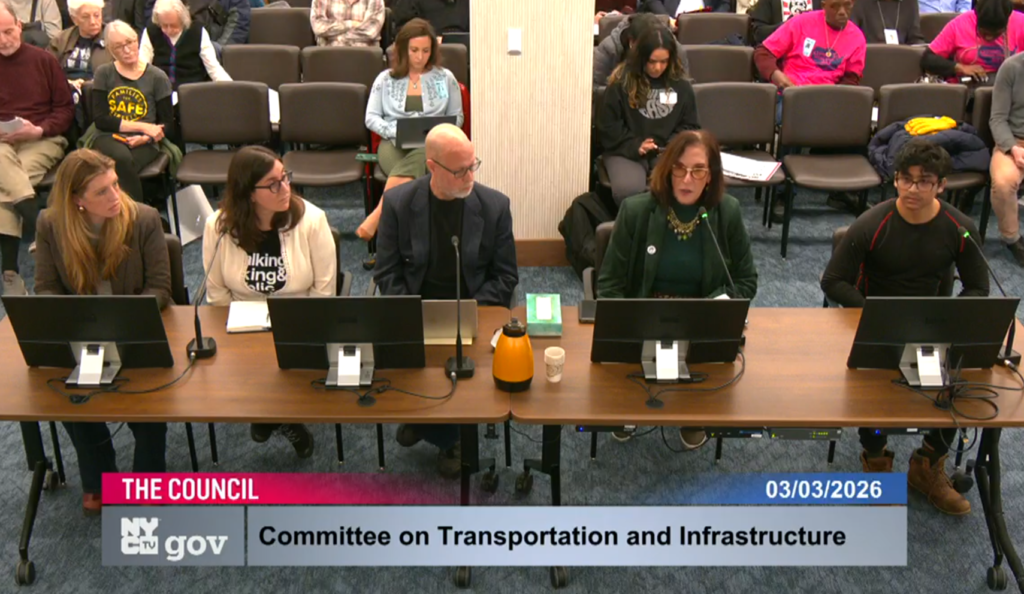
Good day, I’m Lisa Daglian, Executive Director of the Permanent Citizens Advisory Committee to the MTA, PCAC.
Thank you for holding this hearing today. PCAC was created by the state legislature to be the official voice of MTA riders, who are represented on our New York City Transit Riders Council and with a non-voting seat on the MTA Board – though we are working to give that strong voice a vote.
We firmly believe that our city’s buses are engines of opportunity and that the two million riders who depend on them every day deserve the fastest, smoothest trips possible. That’s why we were thrilled with the premise and promise of the Streets Plan mandate. Unfortunately, the previous Administration didn’t keep its promise to riders. We are thrilled that you will have the chance to update the Streets Plan, using the lessons learned of what could have been but fell short. The Streets Plan boldly states that the city’s streets are not just for cars: they are for all of us to use safely and can be reimagined with clarity and inclusion.
It’s not too late to get it right now, even as you look to the next Plan. Riders around the city know that more can be done to keep their buses out of traffic and improve on the woeful average of eight miles per hour they currently travel, which is the worst in the nation. Too many buses literally go slower than a chicken can run, as we found in our joint report with the NYPIRG Straphangers campaign. That is simply not OK, nor should it be a standard for our city. It is past time to invest in meaningful improvements in our bus network. The MTA is doing its part with its borough network redesigns, but DOT has fallen far short of its mandates. At least part of that has been an underinvestment in the human capital needed to make them a reality.
We urge Mayor Mamdani and the Council to work together to staff up DOT so the agency can actually meet the legal mandate created by the Streets Plan and to make it easier, not harder, for DOT to build bus lanes and busways – particularly in our city’s subway deserts and to create viable connections across transit lines.
Fordham Road is a start! Busways are better than bus lanes, which are infinitely better than nothing. A Bus Rapid Transit network would be even better, delivering world class service, which our world class city – and its riders – deserve. We look forward to working with you, the Mamdani Administration and our colleagues in advocacy to make BRT in NYC a reality. That means installing protected bus lanes aligned to the center of streets, avoiding the chronic issues that block New York’s existing curbside and offset bus lanes; continuing to implement technology innovations to speed up buses, such as transit signal priority, and other intersection safety tools such as left turn bans and queue jumps when necessary; and building accessible BRT stations with level boarding.
We urge you to work with DOT and the advocacy community – your willing partners – to help deliver transformative bus priority projects that take into account riders’ input, improve speeds by at least 20% and target pinch points where service is especially slow and heavily used.
Ensuring that everyone can afford to ride is critical, which is why we are calling for expansion of Fair Fares to 300% of the Federal Poverty Level (FPL), allowing those who make less than 150% FPL to ride buses and subways for free, and bringing automatic enrollment to our city.
We also support ensuring that if you’re not a bus, you stay out of the bus lane and the MTA’s Automated Camera Enforcement helps do just that. We support expanding ACE, not rolling it back as some have suggested.
Like you and your colleagues over the years, we have been frustrated with trying to get updates on progress to-date and what’s planned. We strongly support requiring DOT to maintain a capital tracker of its Street Plan projects with monthly updates to connect the plan to tangible projects and their status. Just trying to find how many intersections have Transit Signal Prioritization was a Google challenge, with results ranging from under 1,000 to close to 4,000. It matters and should be easy to find.
The future is bright and bus riders have a lot to look forward to. We look forward to working with you, DOT, the MTA and our colleagues in advocacy to make our city’s streets a place we all feel welcome and safe. Thank you.