
Universal Affordable Transit for New York
First launched in 2019, Fair Fares offers half-fare subway, bus, and paratransit rides to low-income New Yorkers ages 18-64, and is a crucial lifeline of affordability for over 360,000 currently enrolled New Yorkers. After years of pressure on City Hall from Council members, advocates, and riders to launch Fair Fares, eligibility has expanded incrementally from 100% of the Federal Poverty Level (FPL) to 120% in 2023, 145% in 2024, and 150% in 2025. Though this progress is notable, and hundreds of thousands of New Yorkers are paying less for transit today than in 2019, New York City’s eligibility threshold remains among the lowest in the country.
In the post-COVID era, fare evasion and affordability have become fixtures of New York City’s zeitgeist. The Community Service Society of New York’s (CSS’s) 2024 Annual Survey of Housing and Economic Security found that transit hardship affects about 1 in 5 low-income New Yorkers, even with transportation costs in New York City among the most affordable in the country, thanks to public transit. The Fair Fares program offers an unparalleled opportunity to expand access to opportunity, employment, education, and more, but far too few people can qualify under the currently too-low eligibility threshold, including most minimum-wage workers. Fair Fares can complement Mayor-elect Mamdani’s push for free bus service by providing access to the city’s vast subway network and more for New Yorkers who need it.
CSS, PCAC, and Riders Alliance are proud to recommend a five-point plan that will overhaul Fair Fares, improving transportation equity—and lives—while simultaneously addressing our city’s affordability crisis, addressing persistent inequity, and reducing fare evasion:
- Expand Fair Fares to 300% of the Federal Poverty Level (FPL)
- Fully free for households under 150%
- Expand Fair Fares to MTA Express Buses and CityTickets
- Implement automatic enrollment
- Close program loopholes for senior, disabled riders
Since Fair Fares is an existing program administered by the NYC Human Resources Administration with considerable infrastructure at both that agency and the MTA, most of the program expansions discussed can be delivered to NYC residents within months of the new mayoral administration taking office. As such, expanding Fair Fares can be a first step toward delivering greater transportation affordability for New York City residents.
EXPANDED RATIONALE:
- Expand Fair Fares to 300% of the Federal Poverty Level
The Regional Plan Association found that Fair Fares’ current eligibility threshold is lower than all but five similar programs across the United States, despite its highest-in-the-nation transit ridership and infamous high cost of living. Mayor-elect Zohran Mamdani, who made transit affordability a cornerstone of his agenda, can partner with the New York City Council to address this on day one by raising eligibility to 300% of the Federal Poverty Level.
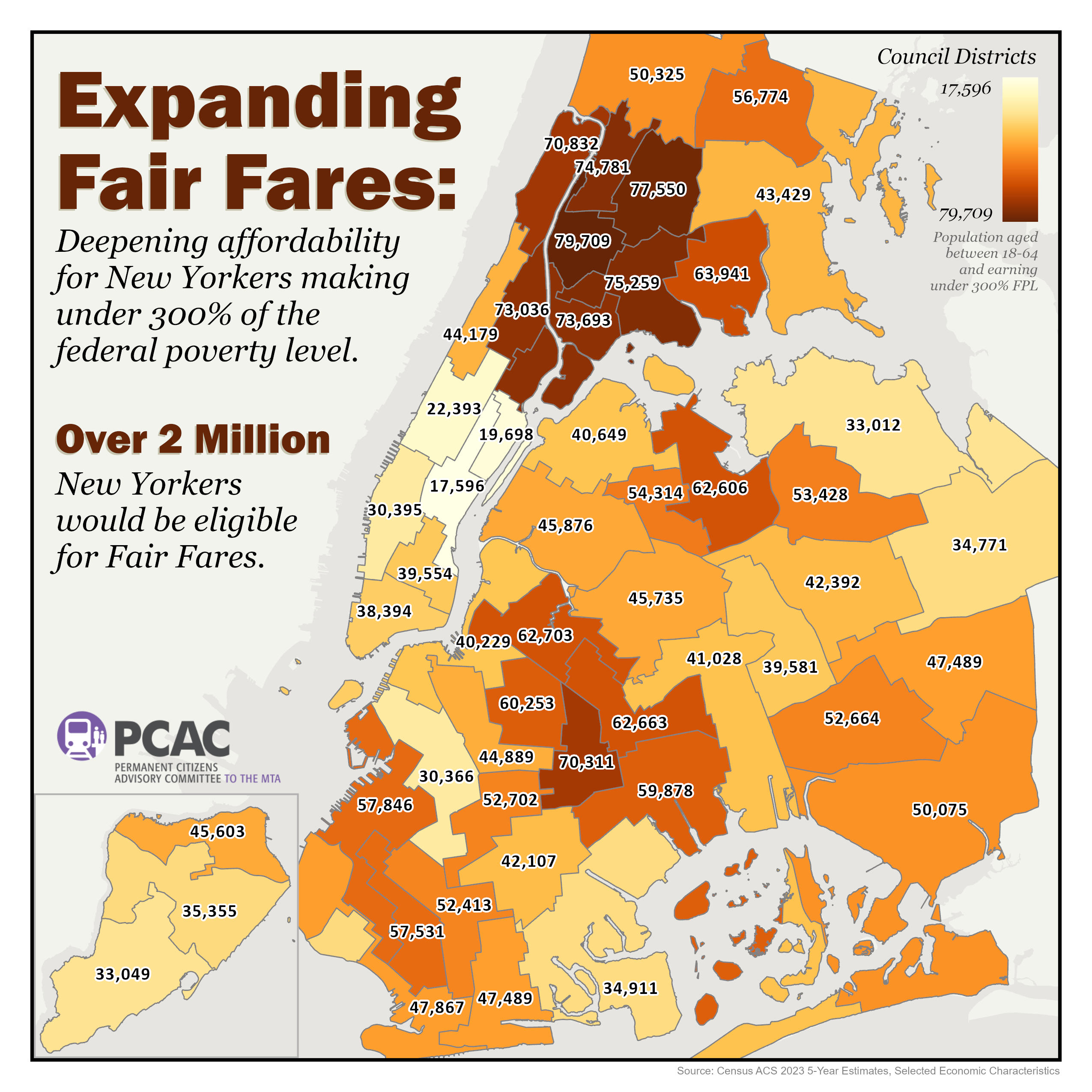
An increase to 300% would cover an individual earning $46,950 and a four-person household earning $96,450 of the Federal Poverty Level (FPL). This would allow an estimated 2.1 million New Yorkers to take part in the program at 300%, including workers making at or close to minimum wage, who are incredibly likely to be transit dependent.
With $96 million already baselined in the New York City Budget, expanding Fair Fares to an additional one million New Yorkers will cost between $125 and $155 million, assuming an enrollment rate of between 40% and 50%. This would be an increase from the current enrollment rate of approximately one-third of eligible New Yorkers.
TAKEAWAYS:
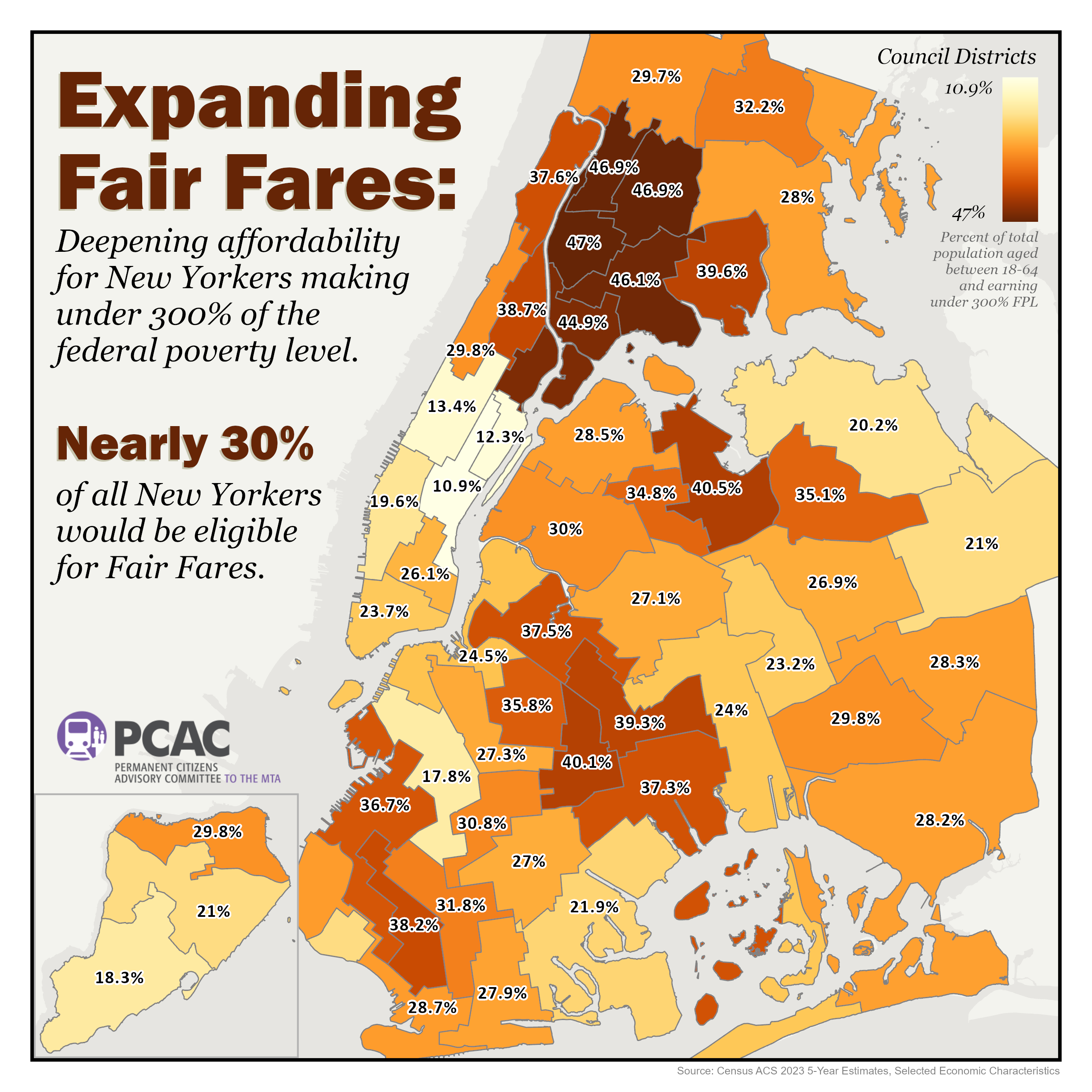
- Expanding Fair Fares to 300% of the Federal Poverty Level would make over 2 million, or 30% of New Yorkers, eligible for half-price or fully free transit fares.
- Over 1 million, or 13% more New Yorkers, would be eligible for half-price transit with the existing Fair Fares program expanded from the current threshold of 150% to 300% of the Federal Poverty Level.
- 24 of 51 Council districts would see over 50,000 residents eligible for Fair Fares.
- 37 of 51 Council districts would see over 25% of their residents eligible for Fair Fares.
- Council districts in the South and Central Bronx would have the highest proportion of residents eligible for Fair Fares.
- 19 Council districts would see an additional 15,000 residents newly eligible for Fair Fares, with the eligibility threshold raised to 300% of the Federal Poverty Level.
Search the table below to find the Councilmembers with the highest proportion of eligible residents at 300% FPL:
In the first ten months of 2025, 65.84% of Fair Fares taps and swipes are on the Subway, and 34.16% are on the bus (excluding Staten Island Railway and Access-A-Ride taps and swipes). Fair Fares riders use the bus at a higher rate than full-fare riders– showing the demand for more affordable bus fares– but the importance of expanding affordability on the subway cannot be overstated. In 2024, daily paid ridership averaged 3.7 million on the subway and 1.3 million on the bus. Particularly at a time when the MTA is focused on reducing fare evasion through a range of methods, including piloting new fare arrays on the subway, ensuring low-income New Yorkers continue to have access to affordable subway service is essential.
TAKEAWAYS:
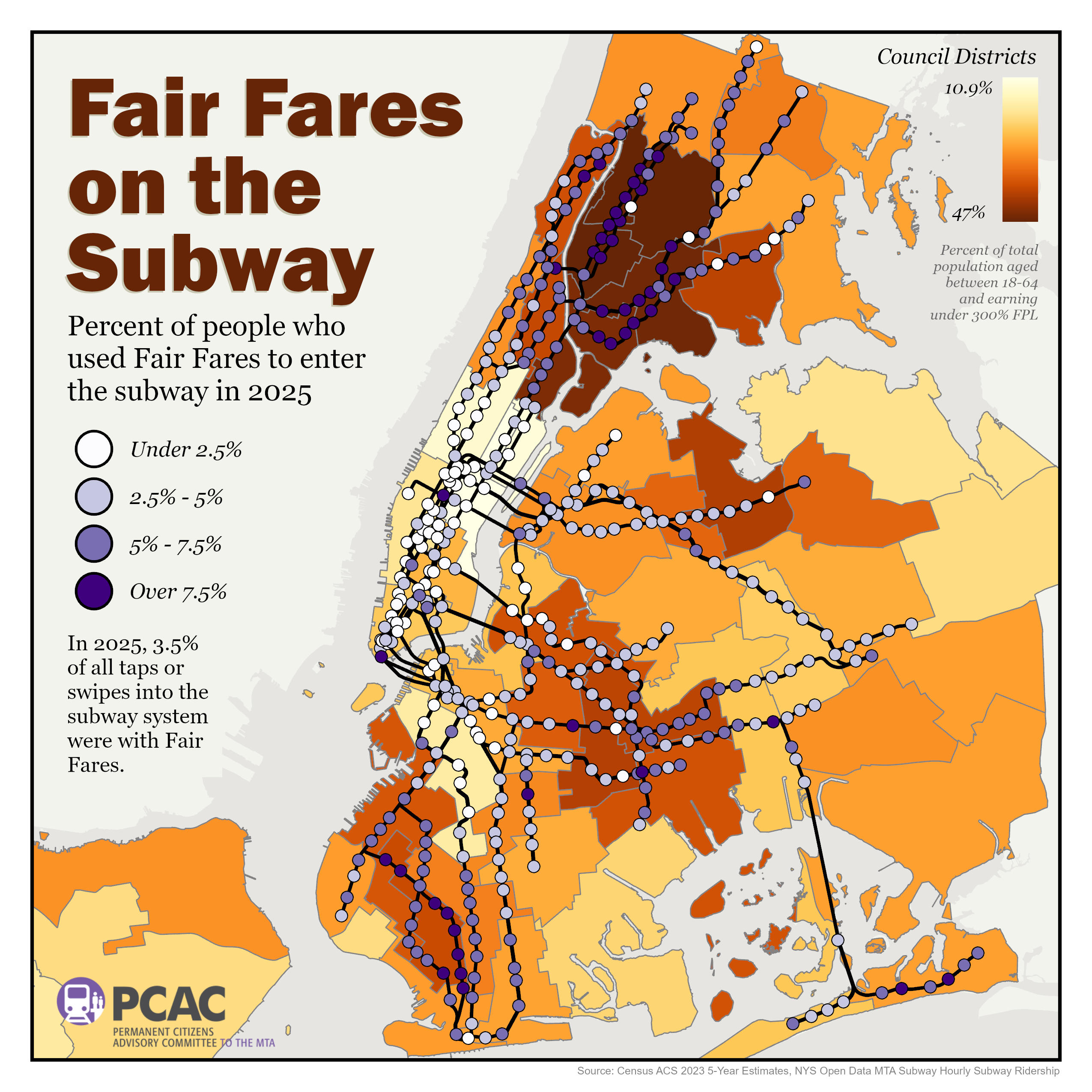
- The subway stations with the highest proportion of Fair Fares ridership overlap closely with the Council districts that would see the largest percentage of residents eligible for the program at 300% of the FPL.
- Fair Fares riders are also traveling to stations in Midtown, the Financial District, Downtown Brooklyn, Flushing, and other key business and economic hubs. Many of these neighborhoods are well-connected to the subway.
- 3.5% of all taps or swipes into the subway were with Fair Fares in the first ten months of 2025.
- Fully free for individuals under 150% of the Federal Poverty Level
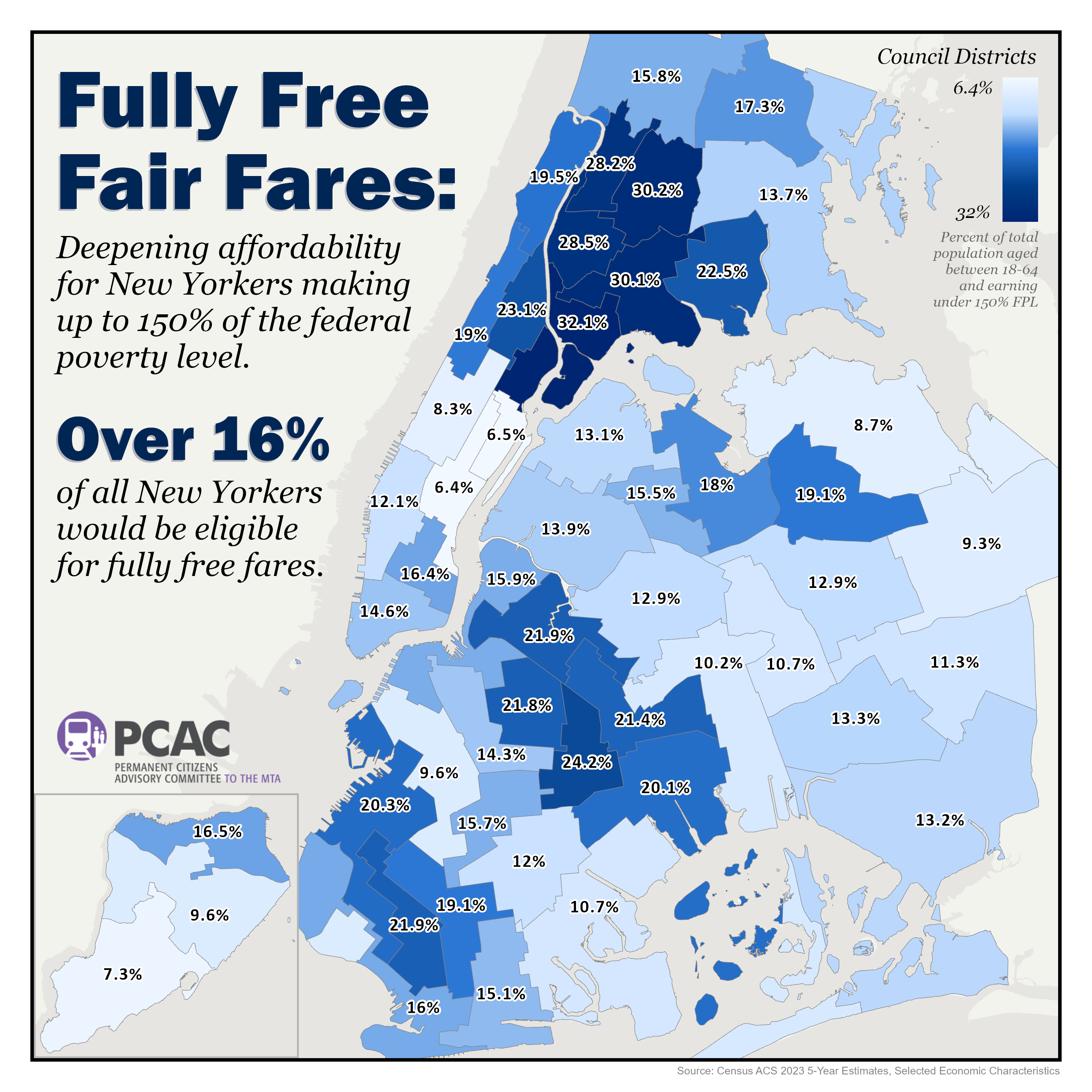
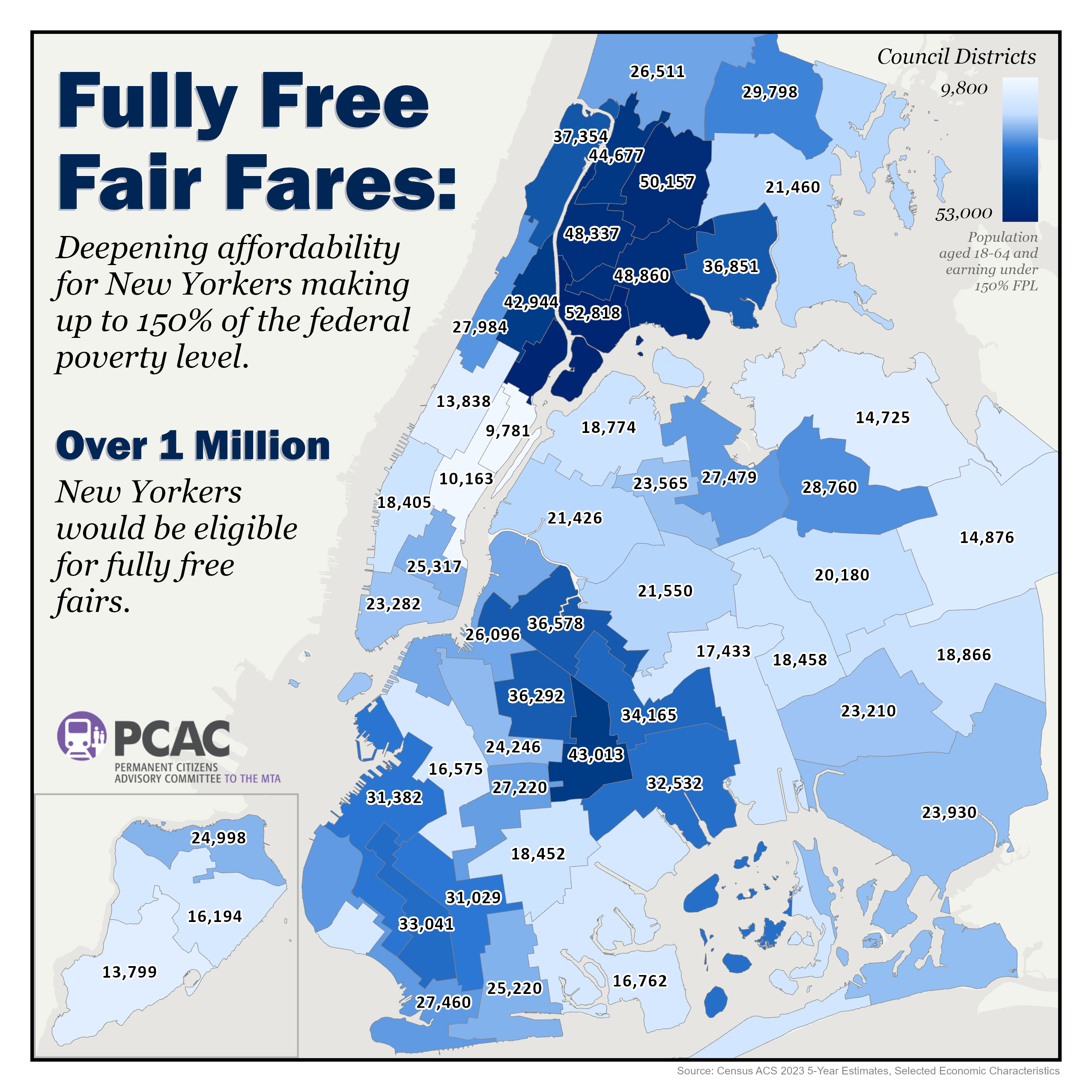
There are over 1 million riders who live at or below 150% of the Federal Poverty Level, $23,475 for an individual or $48,225 for a household of four. These riders currently qualify for half-priced fares. Free buses and subways for these riders is a crucial anti-poverty measure that will allow greater access to employment opportunities and healthcare while alleviating pressure on fixed costs like food and housing.
It would cost approximately $150 to $170 million to deepen affordability for the current million riders who qualify for Fair Fares at or below 150% of the FPL. These numbers also include an increase in enrollment from the current rate up to between 40% and 50% of eligible New Yorkers. This would save 1.3 million New Yorkers up to $910 per year. Fully free Fair Fares would function similarly to the student OMNY card, where transit rides are fully subsidized, but riders tap to access the transit system.
TAKEAWAYS:
- Over 1 million or 16% of New Yorkers aged 18-64 currently qualify for Fair Fares at 150% of the Federal Poverty Level.
- Council districts in the Bronx, Upper Manhattan, and Central and Northern Brooklyn have the largest number of people who currently qualify for Fair Fares and would benefit most from fully free Fair Fares at 150% of the FPL.
- Council districts in Southern and Central Brooklyn, Upper Manhattan, and the Bronx have the highest density of people who would benefit from fully free Fair Fares at 150% of the FPL.
- Expand Fair Fares with half-priced fares on MTA Express Buses and CityTickets
Providing discounted fares on one transit service but not another creates a two-tiered system: one for riders who can afford the transit option that works best for them and one for those who cannot. Expanding Fair Fares via half-priced fares on the MTA’s express bus network, and on the LIRR and Metro-North railroads through a half-priced CityTicket—particularly with the addition of a weekly CityTicket that includes transfers to subways and buses—would allow riders in subway deserts to access whatever mode of transit is most convenient for them and dramatically improve their commutes. The CityTicket’s expansion in recent years was a transformative step toward ensuring that city riders can afford faster trips on the MTA’s commuter railroads, and the program has shown increased ridership at stations across New York City.
But today, the lack of Fair Fares on MTA Express Buses and the railroads costs low-income riders hours and days with family and friends that are instead spent on the slowest buses in America. PCAC analysis found a trip between the Woodlawn and Grand Central takes just 25 minutes on Metro-North but over an hour on New York City Transit. A trip between Rosedale and Atlantic Terminal takes over an hour and a half on New York City Transit but just 36 minutes on the Long Island Rail Road.
Similarly, the MTA must create a single fare zone for weekly and city intracity (within NYC) rail passes as they’ve done with the CityTicket. Uniting the six city zones across the five boroughs into one will link the farthest reaches of New York City with fast, reliable, and affordable regional rail. At $7.25 per peak CityTicket, the siloed model of today makes a round-trip peak trip between Woodhaven and Woodlawn cost $29 round-trip. Though intracity trip distances are myopic relative to suburban commuters, high ticket costs put them out of reach of most New York City residents.
Riders enrolled in Fair Fares deserve the exact same access to the MTA as any other New York City resident.
- Implement automatic enrollment
As the name implies, the implementation of automatic enrollment in Fair Fares would mean that eligible riders would simply be mailed or given their discounted or free OMNY card if they are found to be eligible. Arbitrary hurdles to enrollment and renewal depress Fair Fares’ uptake to just a third of eligible households. These barriers include duplicative application materials, a lack of cross-enrollment with other programs like SNAP, and annual renewal. Automatic enrollment could be enacted through amending the contract language between the City of New York and the MTA.
The City of Philadelphia partnered with SEPTA to automatically enroll low-income riders in a fare-free pilot. The result? The program saw 63% participation in just two years of operation, the highest in the nation among income-based fare discount programs, according to a recent study by the Urban Institute.
“I needed this. I have been telling my council rep how hard it is to get around this place. It is still hard. But this is one big worry off of my chest. And I like how I didn’t have to go begging for it [fare card]. It showed up at my door. I didn’t have to sit on the phone for ages or fill out forms or nothing. I guess he must have been listening, finally.”
– Michelle S., SEPTA Zero Fare Client
- Close program loopholes for senior, disabled riders
Today, Access-a-Ride riders age out of Fair Fares at the age of 65, at which point they must pay the full fare. This quirk results in a rare and inequitable situation where disabled riders actually start to pay more for Access-a-Ride once they become a senior, while most riders have the opposite experience. It’s crucial that seniors, particularly those with disabilities, be able to afford to move around New York City in an accessible and affordable way.
While the majority of Senior riders transition from the Fair Fares half-price fare to the MTA’s Reduced Fare program upon turning 65, this program does not apply to Access-a-Ride, even though Fair Fares does. Riders who qualify for Fair Fares on Access-a-Ride should have their benefits extended past the age of 64 so that they don’t pay double starting on their 65th birthday.
A MANDATE FOR FAST BUSES:
In addition to the Fair Fares program, City Hall’s other main responsibility to transit riders is ensuring their bus can move quickly, safely, and reliably on the city’s streets. As recent research from PCAC, New York City Comptroller Brad Lander, and People-Oriented Cities has highlighted, additional investment in bus infrastructure is needed to improve upon buses’ woeful average speed of just under 8 miles per hour. First and foremost, the city should live up to its commitments – and the legal mandate – in the streets master plan of building 150 miles of camera- or physically protected bus lanes. To date, it has only installed 23 miles.
CONCLUSION:
Fair Fares is a clear complement to Mayor-Elect Mamdani’s mandate for affordability. Acting at the city level, Mayor Mamdani can expand free and discounted transit to millions more New Yorkers across all modes within his first year in office. As we look to make transit more affordable, equitable, and accessible, it’s crucial that the City of New York give riders the agency to decide which mode works best for them, irrespective of income.
ACKNOWLEDGEMENTS:
Report Authors:
Kara Gurl, Planning and Advocacy Manager, PCAC
Brian Fritsch, Associate Director, PCAC
Jack Connors, Research and Communications Associate, PCAC
Research and Data Contributors:
Benjy Ross, Intern, PCAC
Debipriya Chatterjee, former Senior Economist, CSS
Contributors:
Lisa Daglian, Executive Director, PCAC
Jeffrey N. Maclin, Vice President for Governmental and Public Relations, CSS
Rachel Swaner, Vice President of Policy, Research, & Advocacy, CSS
Danny Pearlstein, Policy and Communications Director, Riders Alliance
Caitlin Pearce, Deputy Director, Riders Alliance
Danna Dennis, Senior Organizer, Riders Alliance
Salma Allam, Community Organizer, Riders Alliance