Executive Summary
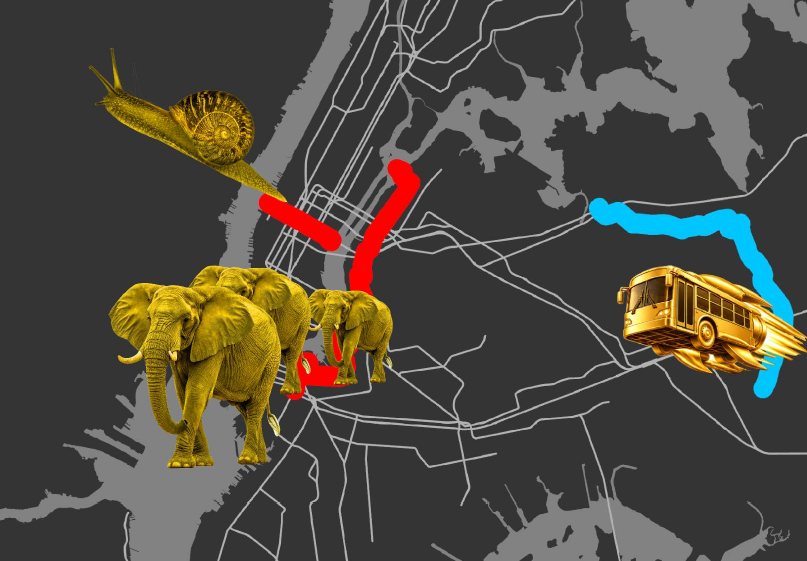
As New York City continues efforts to improve bus service, millions of riders still face slow speeds and unreliable trips that undermine the efficiency of the bus network. The New York Public Interest Research Group (NYPIRG) Straphangers Campaign and the Permanent Citizens Advisory Committee to the MTA (PCAC) return with the 2026 Pokey, Schleppie, and Mazel Awards. The Pokey is given to the slowest bus route, based on average speed. The Schleppie goes to the city’s least reliable bus route, based on customer wait time. The Mazel is awarded to the route with the most improvement in bus speed since last year.
Now in their 19th edition, the awards provide an annual assessment of bus performance, drawing attention to persistent challenges and opportunities for improvement. Building on the implementation of congestion pricing and ongoing Bus Network Redesign initiatives — particularly the Queens Bus Network Redesign, which was completed last year — this year’s findings offer another opportunity to evaluate progress toward faster, more reliable service. The results underscore the importance of sustained investments in dedicated bus lanes, effective enforcement, transit signal prioritization, expanding all-door boarding, and other measures that put bus riders first.
Thankfully, the Mayor’s Office and NYC Department of Transportation (DOT), along with the MTA, have pledged to tackle some of this work via their recently released Next Stop: Fast Buses, Better Service plan. Our awards highlight some of the slowest and least reliable routes, where DOT and the MTA will need to focus their efforts if they are to meet some of the plan’s more ambitious goals.
The 2026 Pokey, Schleppie and Mazel Award “Winners”
Metropolitan Transportation Authority (MTA) and New York City Transit (NYCT) local bus routes with 5,000 or more daily riders were eligible for the 2026 Awards.
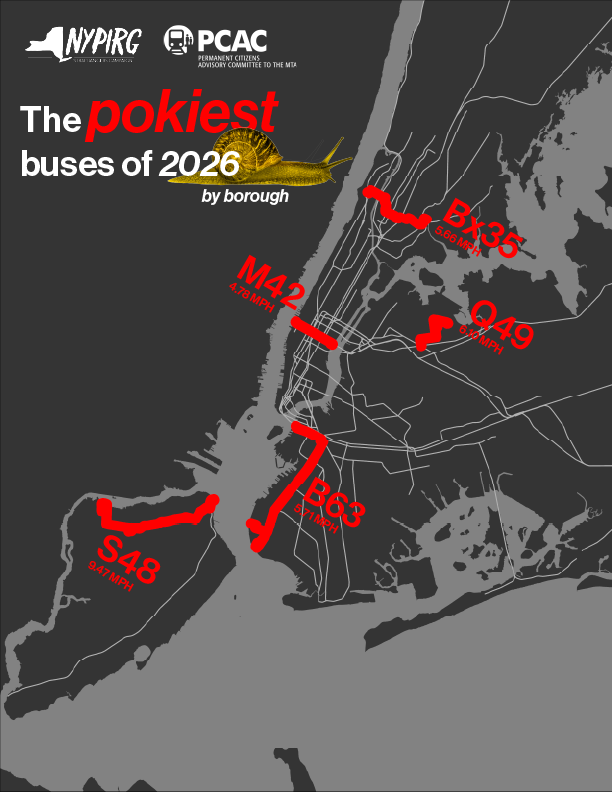
- The “winner” of the 2026 Pokey Award is once again the M42, clocking in at just 4.78 miles per hour (MPH), down from 5.05 MPH in 2025.1 The M42 retained its dubious distinction as the slowest of the high-ridership bus routes in the city, with its declining speed underscoring the persistent challenges facing bus riders.
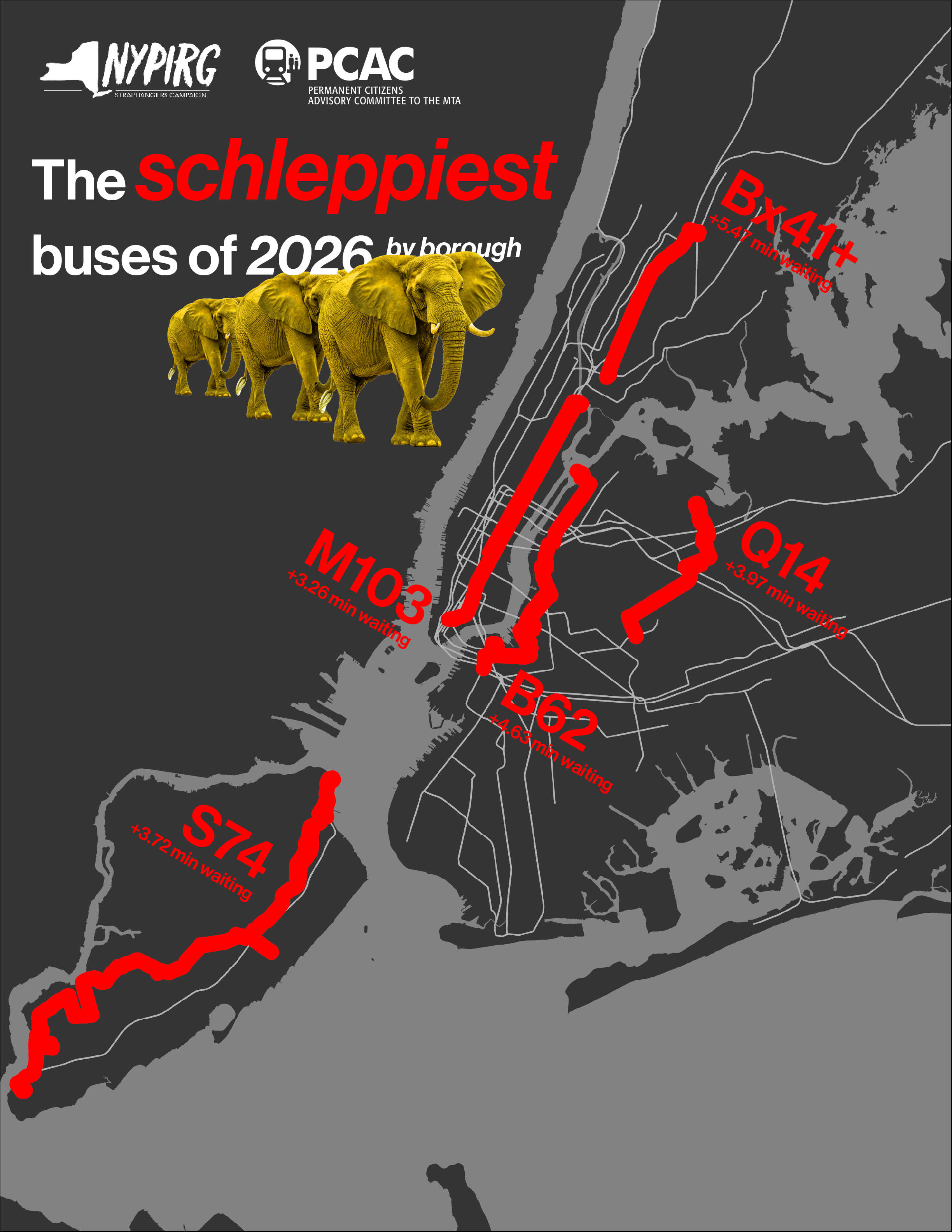
- The “winner” of the 2026 Schleppie Award is the B62, with riders waiting an average of 4.63 minutes longer than the scheduled interval between buses, earning this year’s dubious distinction as the city’s least reliable high-ridership bus route.
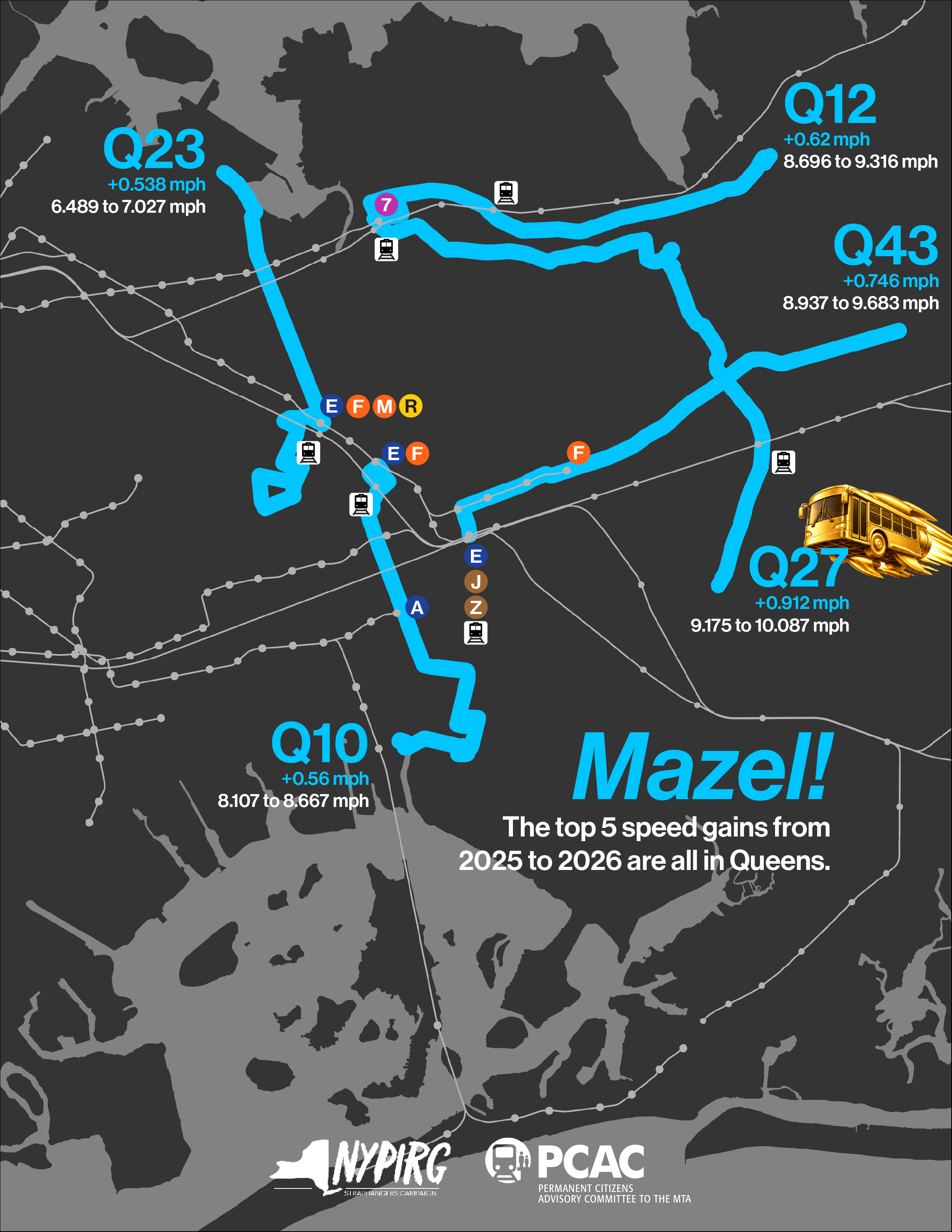
- The winner of the 2026 Mazel Award is the Q27, which recorded a 0.91 MPH increase in average bus speed compared with the previous year. The Mazel Award recognizes routes demonstrating the greatest improvement in speed, highlighting that meaningful progress is possible even as other routes continue to struggle.
Recommendations:
New York City’s buses won’t get faster without giving them priority on our streets. While progress continues, ongoing slow speeds and unreliable service show that more needs to be done.
- Aggressively implement the laudable recommendations of the Next Stop: Fast Buses, Better Service report, particularly the 20% speed increase and reducing bus rider delay at bus stops to less than two minutes beyond the scheduled wait time on 50 Priority Corridors.
- Expand Bus Rapid Transit (BRT), busways, and dedicated bus lanes, particularly along routes where riders continue to face the slowest trips.
- Continue to step up and expand ACE and police enforcement of bus lanes and busways to keep them clear of double-parked vehicles and other obstructions.
- Invest in transit signal priority, improved dispatching, and better management of bus spacing to reduce delays and improve reliability.
- Expand all-door boarding to more bus routes to reduce time spent at stops, speed up service, and make boarding easier for riders.
- Improve the MTA App as well as the data feed to other apps to eliminate ghost buses and improve the reliability of estimated wait times, particularly at the beginning of bus routes.
- Continue the Brooklyn Bus Network Redesign process, ensuring that routes and stops are placed in a way that is conducive to smooth bus operations, takes lessons from the already-implemented Queens redesign, and makes the trip more convenient for riders.
- Invest in the MTA bus fleet and expand the MTA’s depot space.
- Restore the $200 million reduction in MTA Bus operating funding to ensure the MTA has the resources needed to maintain and improve bus service without shifting additional financial burdens onto riders.
Acknowledgements
This report was written by Megan Ahearn and Natasha Elder of the New York Public Interest Research Group (NYPIRG) Straphangers Campaign, and Henry Mei and Kara Gurl of the Permanent Citizens Advisory Committee to the MTA (PCAC). Data analysis was conducted by PCAC. Images were created by Henry Mei and Natasha Elder. Maps were created by Henry Mei with NYC Open Data and mass transit data layers compiled by Anastasia Clark, Frank Donnelly & Zhi Keng He using GTFS data from the Metropolitan Transportation Authority.
Since 1979, the NYPIRG Straphangers Campaign has organized the riding public – college students, in particular – to speak up for affordable fares, more attractive service, and the continued rebuilding and expansion of public transit in New York City.
Created by the New York State Legislature in 1981, PCAC serves as the official, independent voice of riders of subways, buses, Staten Island Railway, Long Island Rail Road, and Metro-North Railroad, advocating for affordability, transparency, accessibility, and equity across the MTA system.