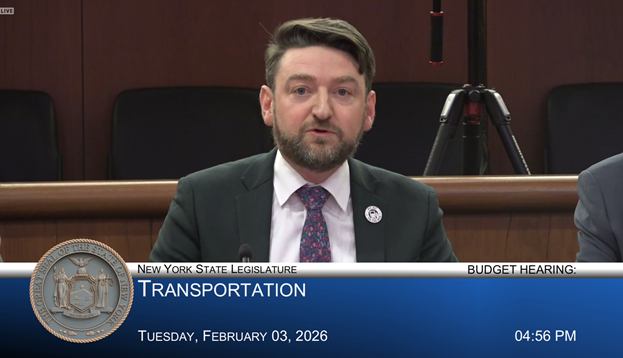
Good afternoon, I’m Brian Fritsch, Associate Director of the Permanent Citizens Advisory Committee to the MTA, PCAC. Created by the legislature in 1981 to represent riders on the MTA’s Long Island Rail Road, Metro-North Railroad and New York City’s subways, buses and Staten Island Railway, our role is to advocate on behalf of riders and advise the MTA on operational performance and capital projects through reports and policy recommendations. Thank you for holding this hearing today and all you do to improve transit for millions of New Yorkers.
To begin, we applaud the Legislature and Governor for their unprecedented support of the MTA over the past three sessions. During this time you have 1) successfully navigated the agency’s operational fiscal cliff, ensuring it has the necessary support to continue to provide safe, reliable and fast service to millions of riders daily, 2) supported the launch of the historic Congestion Relief Program, which will provide $15 billion for finishing the 2020-24 Capital Plan, and 3) provided the needed funding to finance the $68.4 billion 2025-29 Capital Plan, a record investment that will allow the agency to finally, for the first time in its six decades of existence, begin to get ahead of the decay curve on its $1.5 trillion in public assets ̶ in addition to launching transformative projects like Phase 2 of the Second Avenue Subway and the Interborough Express.
It’s now up to the agency to deliver on these unprecedented investments, and organizations like ours to work in partnership with you to hold them accountable. The MTA’s creation of the completely revamped Capital Program Dashboard is one large step in the right direction toward better accountability and transparency, and we look forward to continuing to work with the MTA on efforts to communicate with riders and taxpayers alike to ensure they are as efficient and resourceful as possible.
Making Transit More Affordable
Affordability is the most important priority for New Yorkers today. Following the MTA’s fare increase at the beginning of the year, expanding fare discounts and options around the MTA system has never been more critical. Many transit riders struggle to pay the fare, severely limiting their ability to reach jobs, schools and anywhere transit may take them. It’s one of the reasons we were thrilled when the MTA included our long-time priorities – and yours in the fare changes: allowing seniors and disabled and Medicare riders to use their discounts at all times on the railroads and expanding family fare to age 17. We thank you for your staunch support.
We believe that even more can be done.
- PCAC strongly supports the One City, One Fare Act, S.8620/A.9395 (Comrie/Hevesi), which builds on the success of CityTicket and directs the MTA to conduct a field study of a unified city fare zones, growing intracity ridership and enhancing transit for New Yorkers in subway deserts. Specifically, the bill would:
- Create a single, unified fare zone for all of New York City for both Metro-North and the LIRR, across all ticket types;
- Allow riders to use their city zone LIRR and Metro-North weekly and monthly tickets to transfer freely to the subway and buses on one ticket within New York City;
- Permit riders to also transfer between Metro-North and the LIRR in NYC on the same ticket.
- In addition to the weekly fare cap currently offered to riders of New York City Transit, a 30-Day and Single-Day Fare Cap would help some of transit’s most frequent riders, who faced a fare hike of up to 11% with the discontinuation of the 30-day unlimited MetroCard. Introducing 30-day and single-day fare caps will remedy this issue, ensuring OMNY creates even more flexible and affordable fares.
- The loss of the 10-trip ticket package on the railroads resulted in a 23% increase for some riders. A free 11th trip replaced it, but requires rides to be made in a two-week window and excludes the new day pass, making it is far less useful to riders who used to have a 60-day window to ride. We believe the railroads risk losing ridership, especially during off-peak periods, and among discretionary riders.
- Several recent railroad fare policy changes have also reduced flexibility for riders, such as tickets now expiring at 4:00 a.m. the following day, eliminating the ability to purchase in advance. This change, along with stricter activation windows, higher onboard activation fees, and more limited refund options, which increases risk when trains are delayed or canceled, has made railroad travel more stressful for riders.
- PCAC also supports a new bill, the Ride N.Y. Act, which directs the Departments of Transportation, Motor Vehicles, and the Office of General Services, in tandem with transit providers around New York State, to begin an integrated travel project, enabling contactless fare payment, simplified enrollment in reduced-fare programs for veteran, disabled, senior, and Medicare-eligible New Yorkers, and standardized transit information statewide.
- In addition to state efforts, PCAC has long advocated for the expansion of the Fair Fares program, and recently released a whitepaper discussing a new agenda for Mayor Mamdani’s administration. We believe the program should be expanded to at least 300% of the federal poverty level, to finally include workers making at or close to minimum wage, offer fully free fares for the lowest income New Yorkers at the current level of 150%, and add the commuter railroads in New York City and express buses as options. The program also needs automatic enrollment, as only a dismal third of eligible New Yorkers are enrolled.
Rider Representation and Governance
- We strongly support the Rider Representation Act, S.1148/A.1162 (Gounardes/Dinowitz), which would provide the representatives of the New York City Transit Riders Council, Long Island Rail Road Commuter Council, and Metro-North Railroad Commuter Council on the MTA Board with voting membership along with a new voting board member recommended by the Mayor’s Office of People with Disabilities in consultation with disability advocates. Currently, riders have a voice on the MTA Board — but don’t have a vote. It’s time to change that this year by ensuring riders have official voting seats on the board. Our non-voting members would be in an excellent position to propose changes to the MTA’s fares, except they can’t even make the motions to do so. Giving rider representatives a voice will also help make the MTA Board and Committee meetings more efficient — rider representatives do not count towards a quorum, often making it difficult to reach a quorum and conduct official business.
- We also strongly support the R.I.D.E.R Act, S.7679/A.8169 (Gounardes/Rosenthal), which codifies the independence of PCAC and rider councils from the MTA and broadens the slate of elected officials eligible to recommend members to the MTA’s three advisory councils. It also guarantees regional representation on such councils by providing interim service.
PCAC supports the following aspects of Governor Hochul’s Executive Budget:
- “QWest” aka SAS Phase II, westward expansion: The Second Avenue Subway has been a century in the making, and it’s finally going to bring better transit access to East Harlem, long promised since the destruction of the elevateds decades ago. We applaud Governor Hochul’s commitment to extending the Second Avenue Subway westward on 125th Street, linking seven subway lines and creating better crosstown, East Side, and Metro-North connections for Harlemites. This will truly be a transformative project for tens – if not hundreds – of thousands of riders, offering better access to jobs, education, shopping and entertainment.
- Jamaica Station Rehabilitation Project: Jamaica Station is the fourth busiest rail station in North America, and we are thrilled Governor Hochul is planning to give it the attention it deserves. This is a project decades in the making. Our wish list for a reimagined Jamaica station includes ADA accessible elevators on the west end of the platforms, more plentiful seating, additional restrooms, new dining options and measures to shield commuters from the elements, especially during winter. Combined with the MTA’s current project to eliminate the ‘Jamaica crawl’ and funding for vertical improvements, we envision a day where riders will quickly and seamlessly move though the station no matter their destination.
- Expansion of the SCOUT Program: Governor Hochul is again demonstrating her commitment to transit riders—and all New Yorkers – with her proposal to expand the SCOUT program. Addressing the slate of needs for people experiencing mental health crises through this transformative program has made a real difference, helping those who need it most while improving the riding experience for millions of New Yorkers every day.
- SEQR Reform: SEQR reform is a crucial complement to transit-oriented development projects around the MTA region, simultaneously combating the housing affordability and climate change crises. We applaud Governor Hochul for taking on this common-sense legislation that will cut red tape and encourage more transit ridership across the region.
Thank you for holding this hearing, inviting us to submit testimony, and continuing to prioritize the needs of MTA riders this budget season.